White House Historical Association Silent: The Untold Story Behind the Controversy
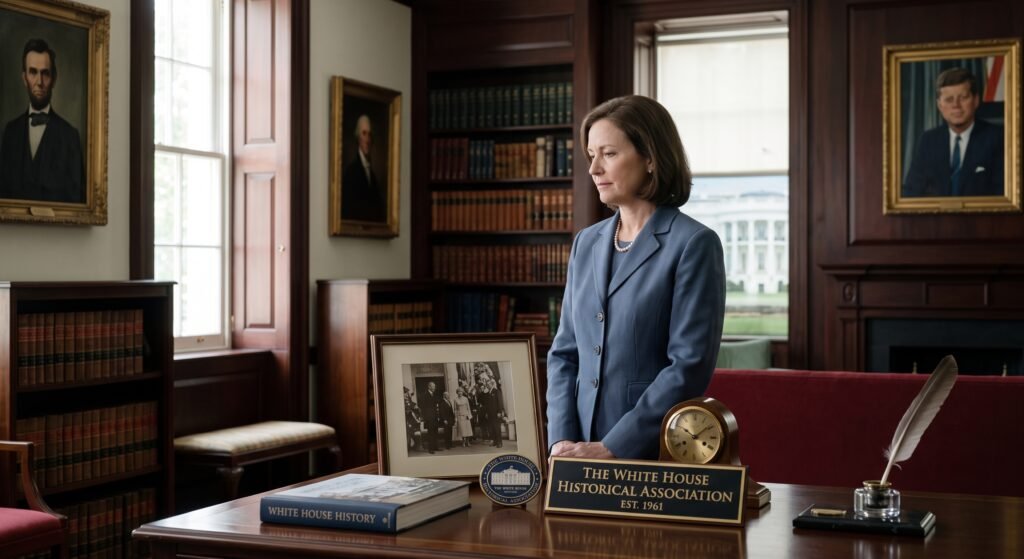
white house historical association silent
The phrase “white house historical association silent” has sparked intense curiosity across news outlets, social media platforms, and historical circles in 2025 and 2026. This isn’t about silence in the literal sense—it’s about a nonprofit organization’s controversial decision to remain publicly quiet during one of the most transformative periods in White House history.
The White House Historical Association, founded by Jacqueline Kennedy in 1961, has long been the guardian of Executive Mansion history. But when President Trump announced plans to demolish the East Wing for a new ballroom, the association’s muted response divided historians, supporters, and critics alike. Understanding this story requires looking at both the organization’s proud legacy and the unprecedented challenges it faced.
Quick Bio
Early Life and Founding
The White House Historical Association was born from Jacqueline Kennedy’s vision to restore dignity and historical authenticity to the Executive Mansion. After moving into the White House in 1961, the First Lady recognized that the building needed both physical restoration and a dedicated institution to protect its legacy for future generations.
On November 3, 1961, the association was officially chartered as a private nonprofit organization. Its dual mission was clear: raise private funds for maintaining and renovating the White House, and create educational resources including an official guidebook. This founding moment established an institution that would operate independently while working closely with each presidential administration.
Education and Mission
From its earliest days, the association prioritized public education alongside physical preservation. The organization publishes the official White House guide, produces the quarterly journal White House History, and maintains extensive digital archives. These educational initiatives have reached millions of Americans through books, webinars, and classroom resources.
The association’s educational scope expanded dramatically in 2024 with the opening of The People’s House: A White House Experience. This 33,000-square-foot interactive museum on Pennsylvania Avenue offers visitors behind-the-scenes access to White House history through replicas, exhibits, and immersive experiences. The center has become a cornerstone of the association’s public mission.
Career Start and Growth
The association’s early work focused on tangible restoration projects and fundraising. Under Nancy Reagan in 1981, the organization launched its iconic White House Christmas Ornament program, which has since sold hundreds of thousands of units annually. Each year’s ornament honors a different president, blending historical education with collectible appeal.
Financial backing grew substantially over the decades. In 2011, financier David M. Rubenstein donated $10 million to establish the David M. Rubenstein National Center for White House History. This endowment enabled expanded scholarship programs, fellowships, and the creation of a comprehensive Digital Library hosted on Amazon Web Services since 2016.
Complete Career Overview
For more than six decades, the White House Historical Association has operated as the primary nonprofit steward of Executive Mansion history. The organization collaborates with the first family, White House chief usher, and curator to maintain state rooms and interpret the building’s evolution. It also funds portraits of each president and first lady, state china services, and restoration projects.
The association’s portfolio includes operating the White House Visitor Center gift shop, publishing award-winning books (over eight million copies sold by 1995), and sponsoring academic fellowships. Its podcast 1600 Sessions and webinar programs for teachers extend its educational reach into digital spaces. Through all these initiatives, the phrase “white house historical association silent” would have seemed unthinkable—until recent events.
Business Ventures and Companies
The association operates several revenue-generating ventures that fund its nonprofit mission. Sales of Official White House Christmas Ornaments constitute a major income stream, with ornaments primarily manufactured by Beacon Design’s ChemArt facility in Rhode Island. The organization also produces wooden eggs for the annual White House Easter Egg Roll.
Book publishing represents another significant business line. The association’s publications cover White House history, art, architecture, and presidential biographies. These titles, along with the quarterly journal, generate both revenue and scholarly credibility. All proceeds support the core mission rather than private profit.
The Silent Controversy
The controversy surrounding “white house historical association silent” erupted in 2025 and 2026 when President Trump moved forward with demolishing the East Wing to construct a new ballroom. According to reporting, association leaders knew about the demolition plans since at least July 2025 but chose not to publicly oppose the president’s decision.
President Stewart McLaurin defended this approach by emphasizing the organization’s documentary rather than advocacy role. “Ours is not to make happen, or to keep from happening—but to document what does happen,” he stated. Critics argued the association should have spoken out to protect historical integrity, while supporters maintained that neutrality preserved institutional credibility.
Latest News and Developments
Despite the controversy, the association achieved a historic milestone in November 2025 by acquiring Norman Rockwell sketches for $7.25 million at auction. The four-panel suite So You Want to See the President! once hung in the West Wing and represents the most significant single-artifact investment in the organization’s history.
The sketches went on public display at The People’s House in June 2026, drawing significant visitor interest. This acquisition demonstrated the association’s continued commitment to preserving White House-related art and making it accessible to the public, even as debates over “white house historical association silent” continued in political circles.
Legacy and Impact
The White House Historical Association’s legacy spans more than six decades of preservation, education, and public engagement. Its work has ensured that millions of Americans understand the White House not just as a workplace, but as a living museum of presidential history. The organization’s neutrality during contentious moments reflects its founding principle of serving all administrations .
The “white house historical association silent” episode will likely be studied by historians as a test case for how cultural institutions navigate political pressure. Whether viewed as prudent restraint or missed opportunity, the association’s approach underscores the complex balance between advocacy and documentation in preserving national heritage.
Conclusion
The White House Historical Association remains one of America’s most important cultural institutions, bridging past and present through preservation and education. While the “white house historical association silent” controversy highlighted tensions between neutrality and advocacy, the organization continues its core mission unchanged. Its recent Rockwell acquisition and expanding public programs demonstrate ongoing vitality.
For those interested in White House history, The People’s House museum offers an unparalleled experience. The association’s publications, digital resources, and educational programs remain accessible to all. Understanding this institution requires recognizing both its achievements and the difficult choices it faces when history unfolds in real time.
FAQ
1. What does “white house historical association silent” mean?
The phrase refers to the organization’s decision not to publicly oppose President Trump’s East Wing demolition plans in 2025-2026, despite knowing about them months in advance.
2. Who founded the White House Historical Association?
First Lady Jacqueline Kennedy founded the association on November 3, 1961, to preserve and educate about White House history.
3. What is the association’s primary mission?
Its mission is to protect, preserve, and provide public access to White House history through restoration, education, and documentation—not to advocate for or against presidential decisions.
4. How did the association respond to criticism about remaining silent?
President Stewart McLaurin stated the organization’s role is to document history, not to support or oppose construction projects. He emphasized neutrality as core to their mission.
5. What major acquisition did the association make recently?
In November 2025, it purchased Norman Rockwell’s So You Want to See the President! sketches for $7.25 million, displaying them publicly starting June 2026.
6. How can the public engage with the association’s work?
Visitors can tour The People’s House museum, purchase Official White House Christmas Ornaments, access the Digital Library, attend webinars, and read the quarterly White House History journal.